
Harold Tessendorf
June 2026
This summer, I’ve had the opportunity to teach about, and work alongside, social enterprises in South Africa and the United States. While preparing for, and again while on my trip to South Africa, I came across some wise insights that I shared with my students and the enterprises alike.
The first is from the South African venture capitalist Jason Goldberg, who in his book The Art of Scale (2024) writes that:
“Revenue is vanity. Profit is sanity. Cash is reality.“
A quote from Sean Summers, the CEO of South African retailer Pick n Pay, also caught my attention. Summers said in an interview with Alec Hogg in 2024, “You can’t save your way to safety. You can only trade your way to safety.”
While working with and advising these social enterprises, I’ve realized that there are three tensions or planes that managers and leaders need to balance on a regular basis. These are captured in the triangular model below. Successful social enterprises strike the right balance between all three, keeping their eye on each one and working diligently to ensure they remain disciplined and hypersensitive to all three of them.
For social enterprises that have been created by traditional nonprofits—to provide them with another source of revenue and to hire their clients to work in the enterprise— remaining attentive to these three dimensions can be challenging. Nevertheless, if followed, this model will increase the likelihood that these enterprises will succeed and, at a minimum, that they will realize a positive double bottom line (flourishing people and profitability).
Let’s explore the model in greater detail.
Social Enterprise Model Diagram
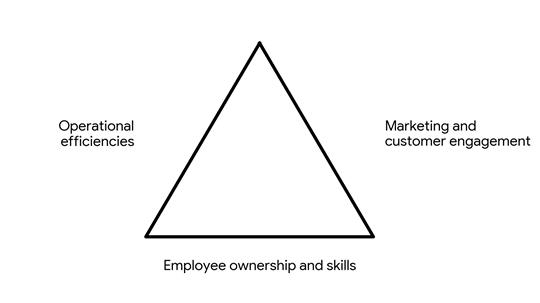
1. Marketing and Customer Engagement
Let’s begin with the right plane of the triangle and the theme of marketing to, and engaging with, the customer. Over this summer, I have been reminded yet again that social enterprise customers are price-sensitive. While they support the mission of the social enterprise, they nevertheless remain sensitive to price fluctuations, especially given the current geopolitical and inflationary environments found in both countries.
It is a flawed assumption on the part of social enterprises to simply assume that their loyal customers will automatically continue to support them when they increase their prices. Yes, loyal customers will support a reasonable price increase that is in line with prevailing market conditions. Yes, customers will pay a bit more to continue to fund the mission as well. But their cash is limited. It is a bad practice to simply increase prices in order to generate more revenue simply to cover operational inefficiencies. (We’ll talk more about this when we address the next plane of the triangle).
It is imperative that social enterprises, just like their traditional business counterparts, remain hypersensitive to the evolving needs and tastes of their customers. They can do so by regularly engaging with those customers who act as their brand ambassadors. They can do so by surveying their market. Simply put, they must question their assumptions. They must use their product to not only educate customers about their mission, but they must also tell the customer when and how to use the product. This starts with a sales staff that engages with the customer and helpful packaging. I love the South African slang word skarreling. It means “to hustle”. Engaging with the customer is the essence of skarreling as a business—being hypersensitive to the customer and marketing continuously to them.
2. Operational Efficiencies
The left plane of the triangle addresses operational efficiencies. When I first meet with a social enterprise, I ask them to explain to me how their economic engine works. How and where do they make their money? How, where, and how much of that money do they spend? A profitable social enterprise has a surplus—a profit—after it subtracts its expenses from its revenues.
It has been my experience that it is very hard for social enterprises to identify what drives their costs and where they specifically make their money. But once they understand these cost drivers, they are in a much better position to realize operational efficiencies and savings.
Going back to the lesson I took away from Sean Summers’ quote: successful social enterprises courageously invest the savings they realize into a better product and better marketing of that product. They will invest it wisely into developing their workforce.
However—and this is the hard lesson—the leaders of these enterprises must be courageous enough to make decisions to close costly and unprofitable ventures and products. This allows them to redeploy those assets into products and activities that generate a higher return. After all, social enterprises are held to a higher standard given their explicit focus on delivering positive social impact (for example, employing people who were formerly homeless) while simultaneously delivering a product or service that their customers values and are willing to purchase.
3. Employee Ownership + Skills
The third plane is the one on the bottom: employee ownership and skills. Social enterprises often employ those who are traditionally considered hard-to-employ. Examples of such categories of workers include people with disabilities, people experiencing mental health challenges, and people who are recovering from and managing addictions.
While all employees, irrespective of their status, need to be motivated by caring and ethical leaders, social enterprises that courageously choose to engage employees who face these extra hurdles encounter unique challenges when seeking to build a culture of employee ownership. Not only must the leaders and managers of these enterprises reinforce the organization’s mission so that employees internalize it and act consistently with it. They must also help them overcome higher levels of low self-confidence and self-esteem, as many of these employees are either current or former clients.
The training programs that these social enterprises conduct, along with the daily coaching that managers provide, must address the three dimensions of what Claudio Chistè calls ownership-driven leadership:
• Owning who you are
• Owning the mission
• Owning the result
All of this must be taught and reinforced alongside the technical skills and competencies that employees need to perform effectively and efficiently as a team that creates and delivers a product that meets the customers’ needs and wants—at a price they are happy to pay.
Conclusion
If you are leading or managing a social enterprise, then I challenge you to step back and look at your organization’s own triangle. Where are you out of balance? Are you ignoring your cost drivers, or have you lost touch with your customers and brand ambassadors? Remember the wisdom of Summers and Goldberg: cash is your reality, and you have to trade your way to safety. Be courageous enough to cut what isn’t working, invest in what is, and build an ownership-driven culture that can weather any storm.
References
Chistè, C. (n.d.). Ownership-driven leadership: Owning who you are, owning the mission, owning the result. [Executive Leadership Framework].
Goldberg, J. (2024). The art of scale: Mastering the craft of growth (Trade paperback ed.). Tracey McDonald Publishers.
Hogg, A. (2024, May). Pick n Pay’s turnaround strategy: CEO Sean Summers on trading your way to safety. BizNews. https://www.biznews.com

