
Balancing the Three Sides of the Social Enterprise Triangle: Reflections from Summer 2026

Harold Tessendorf

June 2026

This summer, I’ve had the opportunity to teach about, and work alongside, social enterprises in South Africa and the United States. While preparing for, and again while on my trip to South Africa, I came across some wise insights that I shared with my students and the enterprises alike.

The first is from the South African venture capitalist Jason Goldberg, who in his book The Art of Scale (2024) writes that:

“Revenue is vanity. Profit is sanity. Cash is reality.

A quote from Sean Summers, the CEO of South African retailer Pick n Pay, also caught my attention. Summers said in an interview with Alec Hogg in 2024, “You can’t save your way to safety. You can only trade your way to safety.”

While working with and advising these social enterprises, I’ve realized that there are three tensions or planes that managers and leaders need to balance on a regular basis. These are captured in the triangular model below. Successful social enterprises strike the right balance between all three, keeping their eye on each one and working diligently to ensure they remain disciplined and hypersensitive to all three of them.

For social enterprises that have been created by traditional nonprofits—to provide them with another source of revenue and to hire their clients to work in the enterprise— remaining attentive to these three dimensions can be challenging. Nevertheless, if followed, this model will increase the likelihood that these enterprises will succeed and, at a minimum, that they will realize a positive double bottom line (flourishing people and profitability).

Let’s explore the model in greater detail.

Social Enterprise Model Diagram
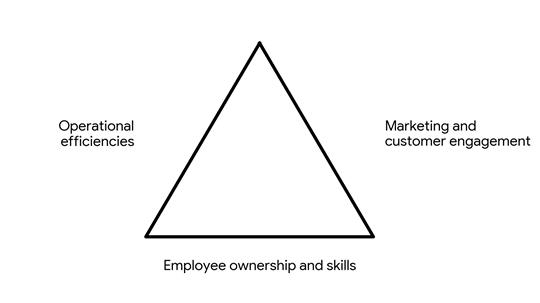
1. Marketing and Customer Engagement

Let’s begin with the right plane of the triangle and the theme of marketing to, and engaging with, the customer. Over this summer, I have been reminded yet again that social enterprise customers are price-sensitive. While they support the mission of the social enterprise, they nevertheless remain sensitive to price fluctuations, especially given the current geopolitical and inflationary environments found in both countries.

It is a flawed assumption on the part of social enterprises to simply assume that their loyal customers will automatically continue to support them when they increase their prices.  Yes, loyal customers will support a reasonable price increase that is in line with prevailing market conditions.  Yes, customers will pay a bit more to continue to fund the mission as well.  But their cash is limited.  It is a bad practice to simply increase prices in order to generate more revenue simply to cover operational inefficiencies. (We’ll talk more about this when we address the next plane of the triangle).

It is imperative that social enterprises, just like their traditional business counterparts, remain hypersensitive to the evolving needs and tastes of their customers. They can do so by regularly engaging with those customers who act as their brand ambassadors. They can do so by surveying their market. Simply put, they must question their assumptions. They must use their product to not only educate customers about their mission, but they must also tell the customer when and how to use the product.  This starts with a sales staff that engages with the customer and helpful packaging. I love the South African slang word skarreling.  It means “to hustle”.  Engaging with the customer is the essence of skarreling as a business—being hypersensitive to the customer and marketing continuously to them.

2. Operational Efficiencies

The left plane of the triangle addresses operational efficiencies. When I first meet with a social enterprise, I ask them to explain to me how their economic engine works. How and where do they make their money? How, where, and how much of that money do they spend? A profitable social enterprise has a surplus—a profit—after it subtracts its expenses from its revenues.

It has been my experience that it is very hard for social enterprises to identify what drives their costs and where they specifically make their money. But once they understand these cost drivers, they are in a much better position to realize operational efficiencies and savings.

Going back to the lesson I took away from Sean Summers’ quote: successful social enterprises courageously invest the savings they realize into a better product and better marketing of that product. They will invest it wisely into developing their workforce.

However—and this is the hard lesson—the leaders of these enterprises must be courageous enough to make decisions to close costly and unprofitable ventures and products. This allows them to redeploy those assets into products and activities that generate a higher return. After all, social enterprises are held to a higher standard given their explicit focus on delivering positive social impact (for example, employing people who were formerly homeless) while simultaneously delivering a product or service that their customers values and are willing to purchase.

3. Employee Ownership + Skills

The third plane is the one on the bottom: employee ownership and skills. Social enterprises often employ those who are traditionally considered hard-to-employ. Examples of such categories of workers include people with disabilities, people experiencing mental health challenges, and people who are recovering from and managing addictions.

While all employees, irrespective of their status, need to be motivated by caring and ethical leaders, social enterprises that courageously choose to engage employees who face these extra hurdles encounter unique challenges when seeking to build a culture of employee ownership. Not only must the leaders and managers of these enterprises reinforce the organization’s mission so that employees internalize it and act consistently with it.  They must also help them overcome higher levels of low self-confidence and self-esteem, as many of these employees are either current or former clients.

The training programs that these social enterprises conduct, along with the daily coaching that managers provide, must address the three dimensions of what Claudio Chistè calls ownership-driven leadership:
• Owning who you are
• Owning the mission
• Owning the result

All of this must be taught and reinforced alongside the technical skills and competencies that employees need to perform effectively and efficiently as a team that creates and delivers a product that meets the customers’ needs and wants—at a price they are happy to pay.

Conclusion

If you are leading or managing a social enterprise, then I challenge you to step back and look at your organization’s own triangle. Where are you out of balance? Are you ignoring your cost drivers, or have you lost touch with your customers and brand ambassadors? Remember the wisdom of Summers and Goldberg: cash is your reality, and you have to trade your way to safety. Be courageous enough to cut what isn’t working, invest in what is, and build an ownership-driven culture that can weather any storm.

References

Chistè, C. (n.d.). Ownership-driven leadership: Owning who you are, owning the mission, owning the result. [Executive Leadership Framework].

Goldberg, J. (2024). The art of scale: Mastering the craft of growth (Trade paperback ed.). Tracey McDonald Publishers.

Hogg, A. (2024, May). Pick n Pay’s turnaround strategy: CEO Sean Summers on trading your way to safety. BizNews. https://www.biznews.com

The Ethical Leader as Herder – How herding cattle in Africa helped me to understand and appreciate ethical leadership

Harold Tessendorf

October 17th, 2022

I was raised on a small farm outside East London, South Africa.  Raising livestock and growing vegetables formed an integral part of our household economy.  My brothers and I were assigned roles in this economy.  One of these was to herd cattle by driving them out to pastures, bringing them in to be milked, and feeding them.  We also had to herd them to neighborhood farms for preventative medical care.   Our cattle were an important household asset, and we came to appreciate the responsibility that our parents had entrusted to us at an early age.  The death or injury of one or more of these cattle would place our family at financial risk.  They represented an important source of my parents’ savings.  The income that we derived from our cattle paid for our expenses, including our schooling.  This meant that as children that we had to be careful herder-stewards.    We had to plan our activities around the times that the cattle had to be moved.  We had to be alert to changes in the weather to safeguard these animals.  We had to be alert to the threats posed by speeding cars and early indications that a cow was ill or about to calve.  All of this taught us at a young age to be alert to the environment and the cattle themselves.  We learnt to read trends and adapt accordingly.   

I learnt that cattle were not uniform and that they could not be treated in the same way.  They had unique personalities and they gelled together to form their own herd hierarchy.  Some of the herd evolved as leaders and matriarchs.  Some had quirks that the others recognized and responded to. This was my introduction to the concept of informal networks that we find in human organizations and to the art of managing personalities effectively.  Our local climate was a harsh one with extremes in heat, drought, and cold.  With good care, our cattle proved to be adept at dealing with adversity.  While out in the pastures and especially when traveling to neighboring farms, I learnt that herding involves both movement and monitoring the situation for problems and anticipating where things will go wrong.    

Herding cattle became such an implicit part of my DNA that it was only later in life that I became aware of how it has shaped my approach to ethical leadership and management.  In addition to the herding stories that I heard and read in the Christian community that raised me, there are three authors who have shone an intellectual light on this phenomenon.  In the paragraphs that follow, I will share their insights before sharing my tentative conclusions that shows how my herding experience helps me to explain ethical leadership. 

The first author is the South African author Laurens van der Post who led columns of the Gideon Force in Ethiopia during the early years of the Second World War.  Van Der Post wrote that as the column leader, he needed to set the daily direction and then remain near the rear of the column.  Experience had taught him that it was near the rear that trouble was most likely to emerge since this was the most vulnerable part of the column.   I have applied this insight when leading organizations and initiatives over the past two decades and found it to be true.  Leaders send their most experienced people up front so that they can give feet to the direction the leader has set.  They can draw on that experience to solve any small problems that arise and they are also mindful of those to come when they select a path that heads in the direction their leader has set for them.  This frees the leader up to monitor and work with the vulnerable parts of the organization. 

Writing in Attuned Leadership – African Humanism as Compass, renowned South African business leader and ethicist, Reuel Khoza, introduces the concept of reciprocal leadership which can be likened to lateral movement.  Khoza defines reciprocal leadership as involving “…the mutual exchange of energy between leaders and followers with this all being based on trust…” and “…growing from the milieu that both the leader and followers inhabit…” (Khoza, 2011: 491).  Followers lend their power to their leaders who reciprocate by empowering their followers.  It is only when leaders enjoy this trust, are sensitive to the expectations and perceptions of their followers and have earned their trust, that leaders can take “bold and unprecedented steps” to achieve a vision.   

The feedback loops that link leaders and their followers serve to energize both parties in a virtuous cycle.  As the leader proves their competence and their alignment with their followers, the followers reciprocate by rewarding them with greater trust and authority.  Influence comes from the leader’s consistent behavior which builds their influence and allows them to project their power far beyond their immediate circle of followers and reports.  Leaders reciprocate by providing their followers with an account for their actions and outcomes.  Questions that they answer include the following:

  • What did you do?
  • Where were you when we needed you?
  • Did we get there?
  • How well did we get there?

David Packard, co-founder of Hewlett-Packard, writes in The HP Way: How Bill Hewlett and I Built Our Company how his management style was influenced by his experiences herding cattle on the ranch that he co-owned with Bill Hewlett.  He went on to write that when he applied too much pressure to hurry the herd along, that his haste and impatience triggered a stampede.  When he applied too little pressure, then the cattle wandered off in different directions on their own.  Packard found that the key was to apply gentle, consistent pressure so that the cattle remained together and on track.  His ranching experience taught Packard to manage others by maintaining a gentle, yet consistent presence.    

Tentative conclusions

  1. Ethical leaders promote the common good.  Their moral compass leads to actions which ripple through their organization into the wider community it represents, resides in, and serves. 
  2. Ethical leaders choose and grow good middle managers from within their organizations.  This reinforces the need that senior management and board members actively and intentionally cultivate an ethical organizational culture.  Good middle managers are the lead cattle in the herd.  They set the pace after they have been given direction by the senior leader.  Ethical leaders know the strengths and weaknesses of their middle managers and understand how best to temper and direct them. 
  3. As part of this ethical culture, leaders invest the resources necessary to create and train the next generation of ethical leaders.  They ensure that the next generation is not only technically competent but also that they also understand the organization’s values and ethos. 
  4. Ethical leaders are present and circulating.  Borrowing again from the herding example, if the front of the herd runs into a problem and must turn back, then they will find their herder moving up to meet them.  In organizations, people will come across the leader who must have the technical competence and confidence to lead their people in that moment. 
  5. Ethical leaders need to be consistent in their message and management style.  Consistent behavior grows the leader’s influence. 
  6. Ethical leaders use the ethical exoskeleton to grow and reinforce the moral endoskeleton inside each of the individuals that they lead.  They model their own strong moral compass and exercise their power judiciously and compassionately.   
  7. Ethical leaders set direction and serve those whom they lead with undivided attention, coaching, commitment, and resources.  Ethical leaders draw from a deep reservoir of values. Ethical leaders are present, strategic, and technically competent.  Power is instrumental, to be treated as something that is used to advance the common good.  This final concept, the idea of promoting the common good, is what is commonly associated with being ethical.  

Sources

Khoza, R.J. 2012.  Attuned Leadership – African Humanism as Compass. Rosebank: Penguin Publishers.

Packard, D. The HP Way: How Bill Hewlett and I Built Our Company.  New York. HarperCollins.

Van Der Post, L. 1974. A Story Like the Wind.  London: Penguin Books.